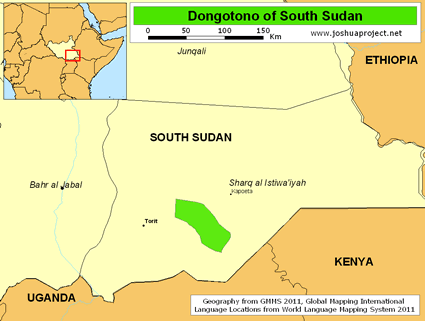
Picture a pleasant walk beside mountains with the villages of the Dongotono perched on ridges high above the plain. Their homeland around the Dongotono Mountains in South Sudan provides a rugged terrain offering some protection from outside influences while allowing them to maintain a distinct cultural identity. Their name is said to mean either "people of the mountain'' or "eating and mourning." The two names reflect their restricted access to healthcare, education, and economic opportunities, and risk of crop failures. Closely related to the Lango and Logir, and like other Lotuka speaking people of the east bank Equatoria, the Dongotono probably arrived at the present location during the great migration in the 19th century.
The Dongotono live in densely populated villages where family and clan relationships form their social organization. Marriage arrangements, conflict resolution and community decision-making are based on clan relationships. The clans, often linked to symbolic animals and age-class, also structure social responsibilities, warfare and ceremonies. Rain chiefs perform both spiritual and administrative functions holding the most celebrated role through hereditary descent. The Dongotono neighbors include the Logirs to the east, Lotukas to the north, Langos to the south, and the Imatongs to the west. They have good relations with the Logirs and Langos.
The livelihoods of the Dongotono are based on subsistence farming of sorghum, groundnuts, sesame, sweet potatoes and other staples. They also raise cattle, goats and sheep, which are central to both their economy and cultural life. Like neighboring groups, they sometimes engage in cattle raiding, which historically played a role in prestige and survival. The Dongotono language remains an important marker of identity. However, limited published information is available regarding education, literacy, urbanization and other aspects of contemporary life among the Dongotono.
The vast majority of the population identifies as Christian with significant Roman Catholic influence. However, in practice, the Dongotono still hold many traditional religious beliefs which include reverence for ancestral spirits and a worldview in which the spiritual realm directly affects daily life. Traditionally, they believe that a person's spirit may become connected with a clan-associated animal after death. They bury their dead, but like other neighboring communities, they have a practice of exhuming the corpse or the bones of the dead in anticipation of one's transformation into the clan animal. The Dongotono revere the Sawa/Asawa, a sacred grove in the Dongotono massif where together with the Logirs, they perform annual rain rituals. Traditional specialists such as fortune tellers, mediums and ritual practitioners have historically been consulted to address illness, misfortune or uncertainty about the future.
Many Dongotono communities face challenges related to poverty, limited infrastructure, educational shortages and restricted access to healthcare. The isolation of rural, mountainous villages affects outside assistance reaching them. Families would benefit from improvements in medical care, clean water, education and economic opportunities. Agricultural livelihoods are highly dependent upon rainfall and seasonal conditions, making communities susceptible to crop failures and food insecurity. Dongotono communities need sustainable agricultural development. Changing weather patterns and seasonal uncertainty risk crop success. Greater access to agricultural training and improved farming methods would strengthen food security and community resilience. Regional instability calls for reconciliation and peacebuilding efforts among inter-clan conflicts and neighboring people.
Spiritually, there is a need for mature discipleship and biblically grounded indigenous church leadership. Literacy programs are needed to support language preservation and Scripture engagement.
Pray that Dongotono believers will grow in their knowledge of God's word and develop a vibrant, Christ-centered faith.
Pray that pastors and church leaders will be equipped with wisdom, biblical understanding and servant hearts.
Pray that the churches among the Dongotono will become a source of spiritual renewal and a missionary force to unreached peoples.
Pray for effective discipleship of children and young adults so that the next generation will faithfully follow Christ.
Pray for greater access to scripture, Christian teaching materials and ministry resources in the Dongotono language.
Pray for peace, stability and reconciliation throughout the region that displays Christ-transformed believers.
Pray for improved healthcare, clean water and educational opportunities for families and villages.
Pray for successful harvests, food security and sustainable livelihoods.
Pray that the love and hope of Jesus Christ will be clearly demonstrated through the lives of Dongotono believers.
Scripture Prayers for the Dongotono in South Sudan.
https://www.101lasttribes.com/tribes/dongotona.html
https://riftvalley.net/news/sudan-and-south-sudan/letter-isoke-no-5-walk-network/
| Profile Source: Joshua Project |